
How Much Does a TimberTech Deck Cost?
It's the first question almost everyone asks us, and it's a fair one. You're about to spend real money on your backyard and you want to know what you're walking into.
Here's the honest part. Two decks with the same square footage can land in very different places. A low 12x16 deck off a walkout is a different job than a 12x16 deck ten feet in the air with two runs of stairs. So instead of a made up price chart, we're sharing real numbers from our own jobs, and then showing you exactly what moves the number so nothing in your quote surprises you.
If you're still deciding on materials, start with our complete TimberTech decking guide. This post focuses on cost.
Get Your Free Estimate
What our last 20 TimberTech decks cost
To give homeowners a realistic starting point, we pulled the pricing from our 20 most recent TimberTech decks.
Average size: about 390 square feet.
Average total price: about $35,000.
Price per square foot: anywhere from $60 to $155, with many landing around $90.
Every deck we build is custom, so treat these numbers as a baseline, not a quote. The rest of this post explains why one deck lands at $60 a square foot and another at $155.
Want a number for your deck?
The fastest way to get a ballpark is our online deck estimate tool. Put in your size and a few details and you'll get a starting point in a couple of minutes. When you're ready for a real price, we'll come out, measure, and walk you through options.
What actually drives the cost of a TimberTech deck
1. Size, but less than you'd think
Square footage matters, but it isn't the whole story. Stairs, railing, footings and getting set up on site cost about the same whether the deck is big or small. That's why a small deck often costs more per square foot than a larger one.
2. Height off the ground
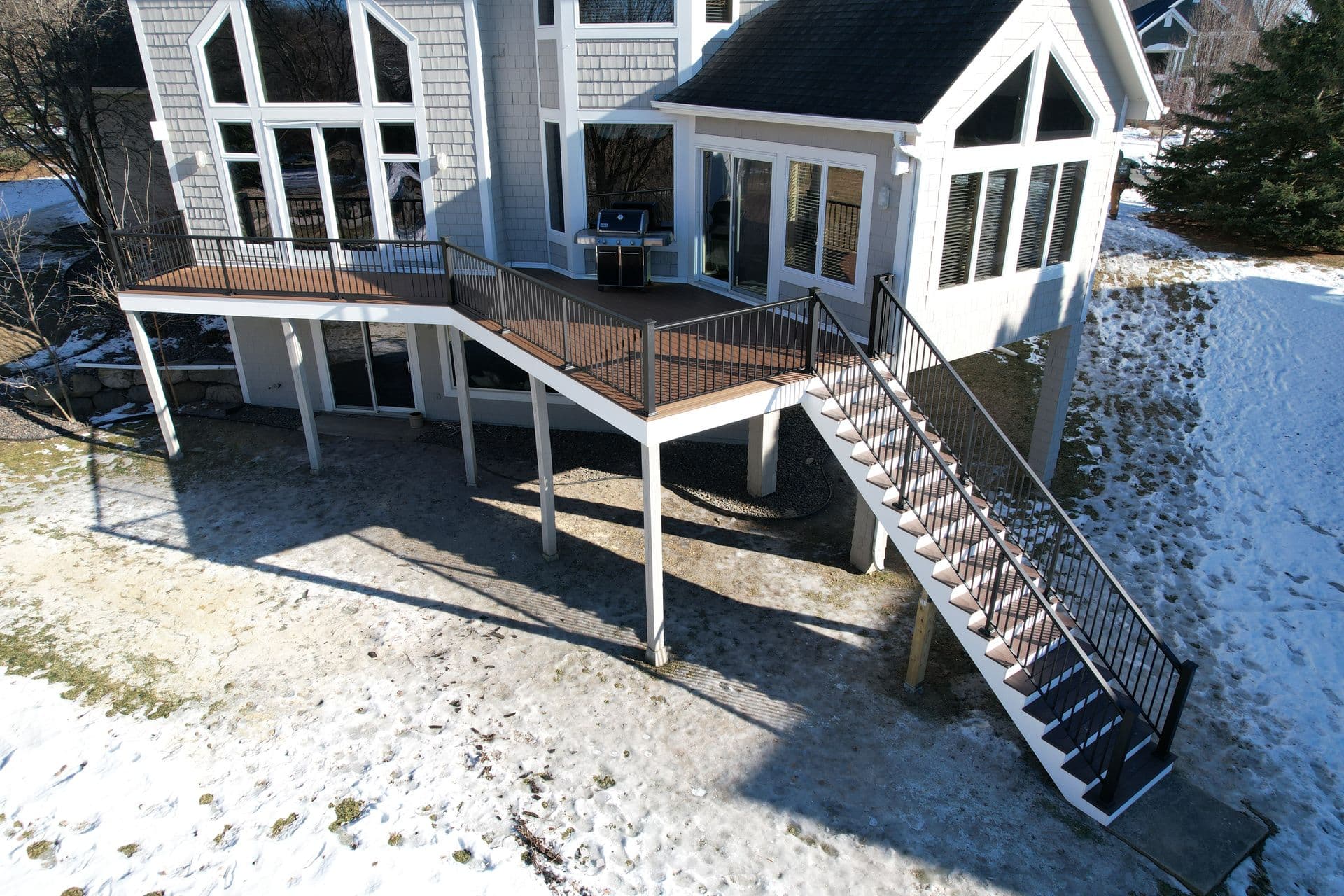
A deck close to the ground needs short posts, little or no railing, and maybe one step. A second story deck needs taller posts, more bracing, full railing and a longer stair run. Height is one of the biggest swings in price.
3. Stairs
Every stair run adds framing, footings, treads, risers and railing on both sides. A wide stair or one with a landing adds more. If there's more than one way to lay out your stairs, the choice can make a real difference in the budget, and we'll show you the options.
4. Railing
Railing is often the second biggest line after the decking itself, especially on raised decks where it wraps the whole perimeter. We install Westbury, Kadenz, RDI and TimberTech railing systems. Price depends on the brand, the style (aluminum balusters, cable, glass, drink rail), the total length, gates and whether you add lighting.
5. Which TimberTech board you choose
TimberTech makes two families of decking:
Composite. This is what most of our customers choose, and the Reserve collection is the one we install most. It has a rich, reclaimed wood look, it's capped on all four sides, and it carries a 30 year product and fade and stain warranty from TimberTech.
Advanced PVC. No wood fibers at all, better moisture resistance, and longer warranty coverage. It costs more than composite. It's a great fit near lakes and pools, on shaded decks that stay damp, or for homeowners who want the top of the line. PVC also cools down faster once the sun drops, which is nice if you mostly use your deck in the evening.
Within each family, collections are priced differently. Multi tone, wood grain boards cost more than solid colors.
6. What's under the boards
This is where quotes really differ, and where you should look closest.
On our decks we typically use:
Helical piers instead of poured concrete footings. They're screwed down below the frost line, they hold up to Minnesota freeze and thaw, and they let us build all winter long. You don't have to wait for spring.
2x10 joists. Stiffer framing means a flatter, more solid deck under composite and PVC boards.
Proper ledger flashing and joist protection where the deck meets your house, because water at the ledger is the number one way decks fail early.
None of this shows in photos, but it's what decides whether your deck lasts 10 years or 30.
7. Tearing out the old deck
Most of our projects are full replacements, so demolition and haul away are part of the price. Bigger or taller old decks, concrete footings that have to come out, and tight backyard access all add time.
8. Can you reuse the old frame?
Sometimes. When we look at an existing frame, we ask two questions. Is it structurally sound enough to reuse? And can it be grandfathered in under current code? If the answer to both is yes, reusing it can save money. If not, putting new boards on an old frame is money poorly spent. New boards don't fix rotted joists or a bad ledger.
9. Finishing details
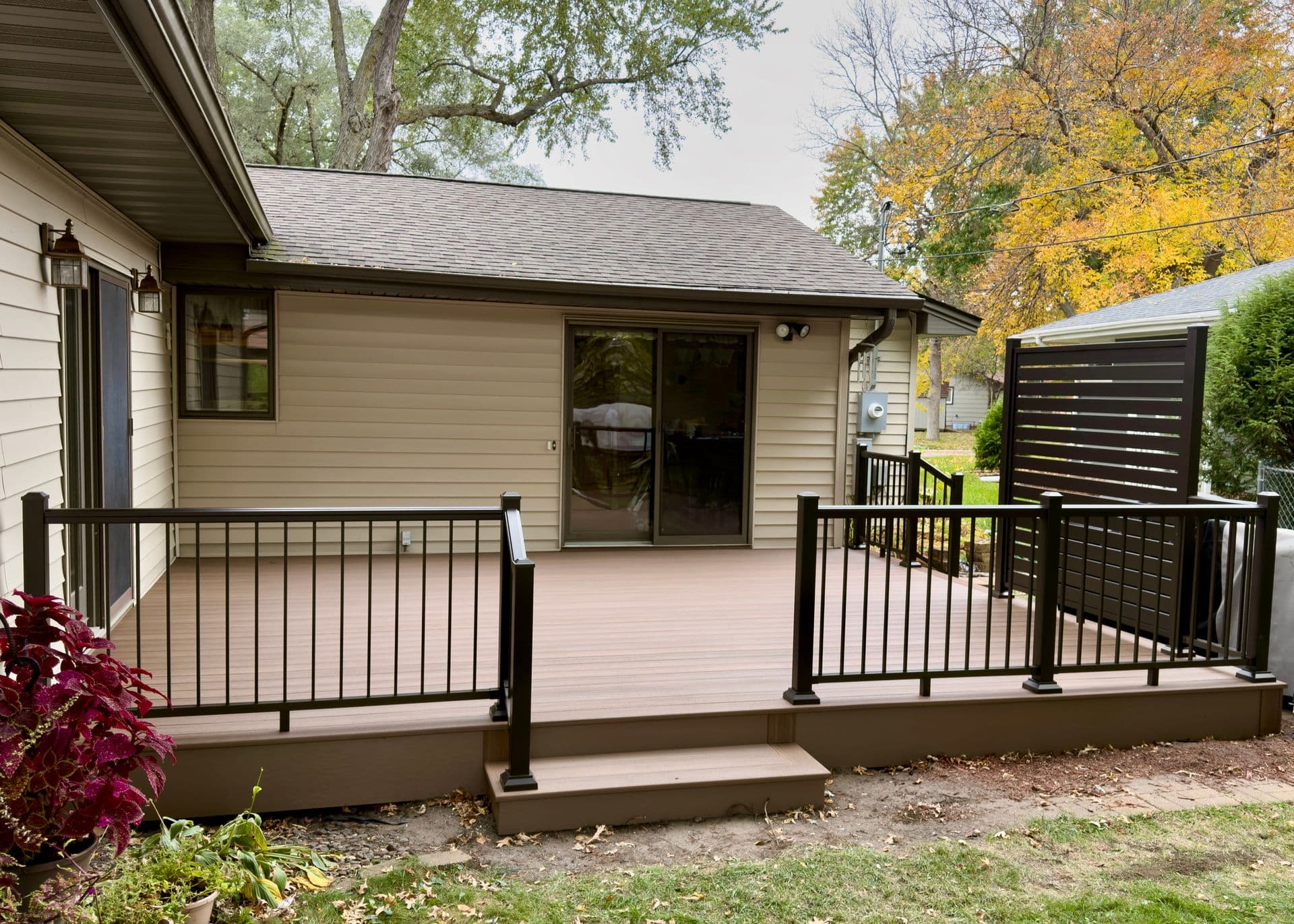
Picture framing (a border board around the edge), fascia to cover the frame, stair and post lighting, privacy walls and underdeck systems all add cost. You don't need every upgrade to get a great deck. We'll help you decide which ones are worth it for how you use the space.
10. Permits
Most deck replacements need a permit, and every city handles it a little differently. Plymouth, Maple Grove, Minnetonka and Brooklyn Park each have their own review and inspection steps. We pull the permit, build to code, and meet the inspector, and that's included in our process.
Is TimberTech worth more than wood?
Upfront, a TimberTech deck costs more than a basic pressure treated wood deck. The difference is smaller than most people expect, though, because the boards are only one part of the total. The framing, footings, stairs, railing and labor cost about the same either way.
Where TimberTech pays you back is every year after. There's no sanding, staining or sealing. There are no splinters, and no gray, cracked boards in five years. For a lot of our customers, getting their weekends back is the whole point.
How to compare deck quotes
If you're getting more than one bid, line them up against these questions:
- Is the old deck fully removed and hauled away?
- What footings are included, helical piers or concrete?
- What size joists, and is the ledger flashed?
- Which TimberTech collection, and which railing brand and style?
- Are stairs, fascia and picture framing included?
- Is the permit included?
- What labor warranty comes with it?
A lower price often means something on that list is missing.
What you get when MWCR builds your deck
We're a family and minority owned company based in Plymouth, and decks are a big part of what we do.
TimberTech Gold Pro. That status is earned through training and installation volume.
10 year labor warranty on every deck we build.
TimberTech replacement labor coverage. As a Gold Pro, our decks qualify for 10 years of replacement labor coverage from TimberTech, or 12 years when you choose TimberTech railing.
Winter builds thanks to helical piers.
Flexible payment options so the deck you want fits your budget.
Ready to price your deck?
Try the deck estimate tool for a quick starting point, or book a free deck consultation and we'll measure, design and price it with you. You can also see our deck replacement work here.
FAQ
How much does a TimberTech deck cost?
Our 20 most recent TimberTech decks averaged about $35,000 for around 390 square feet. Per square foot, they ranged from $60 to $155, with many around $90. Your price depends on size, height, stairs, railing, the TimberTech collection and what's underneath. For an exact price, we measure on site.
Why does a small deck cost so much per square foot?
Stairs, railing, footings and setup cost about the same no matter the deck size, so they make up a bigger share of a small project.
Is TimberTech composite cheaper than Advanced PVC?
Yes, in most cases. Composite is the more budget friendly TimberTech option. Advanced PVC costs more but has no wood fibers and longer warranty coverage.
Does railing add a lot to the cost?
Yes. On raised decks, railing is often one of the largest costs. Brand, style, total length, gates and lighting all affect the price.
Can I save money by keeping my old deck frame?
Sometimes. It has to be structurally sound and able to be grandfathered under current code. If it isn't, new boards on an old frame aren't a good investment.
Can you build a deck in the winter?
Yes. Because we use helical piers instead of poured concrete, we build decks all winter.
What warranty comes with an MWCR deck?
Every deck includes our 10 year labor warranty, plus TimberTech's product warranty on the boards. As a Gold Pro, our decks also qualify for TimberTech's replacement labor coverage.
Related reading
TimberTech Composite Decking: Everything Minnesota Homeowners Should Know
Contact Us
Mon-Fri: 7am-8pm
Sat: 9am-5pm
Sun: Closed